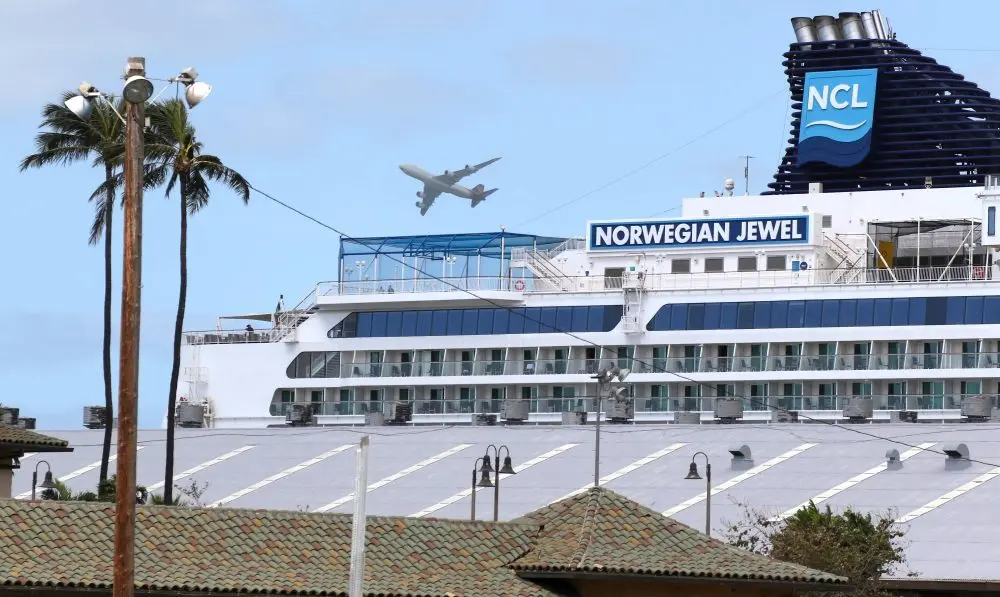
As the cruise industry and the state spar in court over Hawaiʻi’s new green fee, state lawmakers are moving full steam ahead to remove those ships from the landmark climate law and have them instead pay a new fee of around $10 per passenger.
Such a change, however, would drastically shrink the total dollars going into the green fee, state tax projections show, and limit its ability to deal with overtourism, natural disasters and climate change.
The bills in the House and Senate have passed the first legislative committees they needed to clear.
“The main point for this is to find a middle ground so that we avoid heavy litigation costs and a drawn-out process,” said Rep. Adrian Tam, who chairs the House Tourism Committee.
The bills are advancing as a lawsuit filed by the cruise ship industry moves through federal appeals court. Oral arguments in the Cruise Lines International case, which the Trump administration joined, are slated for April. The state Attorney General’s office has expressed confidence that it will prevail in court.
Tam, in a hearing last week, said “it seems like we’re reversing course” on whether the cruise ship portion of the green fee was defensible. Deputy Attorney General Yvonne Shinmura said she didn’t have an answer because she wasn’t handling the litigation.
Gov. Josh Green long championed the green fee and made it one of his administration’s top priorities. On Monday, his office said it does not comment on bills moving through the Legislature and it would weigh in at “an appropriate time.”
Notably, the state Department of Transportation supports removing cruise ships from the green fee and adding the per-passenger fee, even though it would collect millions of dollars less each year.
A Big Slice Of The Pie
Cruise ships are projected to pay nearly a third of all green fee revenues. Those dollars aim to cover a range of projects across the nation’s lone island state, from native species and habitat restoration to wildfire prevention.
If the ships remain subject to the green fee, the state Department of Taxation estimates they’ll contribute some $26 million to it in fiscal year 2027, which starts July 1, the first full year of collections.
By contrast, the pair of bills advancing in the state House and Senate would enable the ships to pay around $10 million annually in passenger fees instead. That legislation would limit those dollars to harbor improvements, while the green fee proceeds primarily paid by hotel guests would fund various projects across the islands.
Officials with Norwegian Cruise Line Holdings, which operates the only year-round U.S.-flagged cruise ship in Hawaiʻi, support the proposed changes, they say, because the per-passenger fee would be spent directly on harbor facilities.
That approach “extends to improving the experience of guests and the ship itself,” Sandra Weir, the company’s vice president for government relations, recently told state senators during a hearing.
Care for ʻĀina Now, a coalition of environmental groups that advocated for the nation’s first-ever green fee, is concerned about the bills.
“It is critical that cruise visitors contribute meaningfully and equitably,” its leadership committee wrote in testimony. Any alternative to the green fee, they added, should have “cruise visitors contribute on equal footing with other travelers” and support the green fee’s “same core priorities.”
Shore Power?
Dreana Kalili, state deputy transportation director for harbors, has said much of the passenger fee dollars collected from cruise companies could still fund at least some climate change-related projects.
Specifically, they could be used to fund what’s known as “shore power,” where the ships could turn off their engines and plug into the cleaner electrical grid while in port. Weir said the Norwegian ships are compatible with shore power. State transportation officials estimate it would cost around $100 million to install shore power infrastructure at Honolulu Harbor’s Pier 2 alone.
The cost estimates for shore power in neighbor island ports vary, those officials say, based on grid capacity, needed upgrades and other factors. The per-passenger fees could also be used, Kalili said, to raise piers at the ports that will be underwater in the coming decades due to sea level rise.
Hawaiʻi sees more than 300,000 cruise ship passengers each year. The new per-passenger fee would be charged at each of the several ports their ships visit. Weir said the charges would roughly double the $41 in total fees per passenger the cruise ships already pay to visit the ports in Honolulu, Nāwiliwili, Kahului and Hilo.
Those existing fees fund general harbor improvements, Kalili said, while the new fee would mostly target improvements that benefit the cruise ships.
Losing green fee dollars is a “huge concern,” Tam said, but the cruise industry brings in a lot of business “and we do value their presence.”
The House and Senate bills have each been referred to be heard in those chambers’ money committees next. Those hearings have not been scheduled.
___
Civil Beat’s coverage of climate change and the environment is supported by The Healy Foundation, the Marisla Fund of the Hawai‘i Community Foundation and the Frost Family Foundation.
Story originally published by Honolulu Civil Beat and distributed through a partnership with The Associated Press.